South Africa’s central bank governor has warned that ongoing turmoil in the Middle East is making it difficult to justify any near-term interest rate cuts, citing heightened volatility and inflation risks.
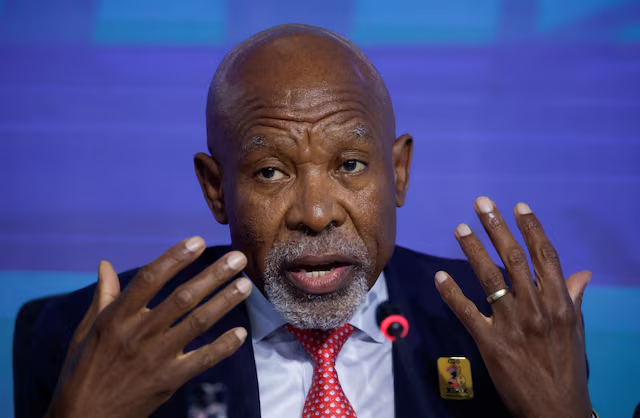
Speaking to Reuters on the sidelines of the International Monetary Fund and World Bank Group spring meetings in Washington, South African Reserve Bank Governor Lesetja Kganyago said the conflict’s impact on global prices—particularly commodities such as fuel and fertilizers—remains highly unpredictable.
Kganyago noted that the bank is relying on scenario-based analysis rather than updating its inflation or growth forecasts between policy meetings, due to the scale of uncertainty.
“All that we know is that it is growth-negative and would also lead to a rise in inflation,” he said, referring to the war’s economic impact. “In an environment where inflation is expected to rise, it is difficult to argue for any relaxation of monetary policy.”
The central bank held its benchmark interest rate steady at 6.75% last month, emphasizing caution amid concerns over rising energy costs and their knock-on effects on inflation.
Ahead of that decision, policymakers developed risk scenarios, including one in which oil prices average $94 per barrel for the year and the currency weakens by 20%. However, Kganyago said conditions have already shifted significantly since then.
“That was in March. We are now in a completely different environment,” he said, adding that updated scenarios will be prepared in May.
The conflict has disrupted expectations of monetary easing across many emerging markets, as sharp swings in commodity prices complicate inflation outlooks.
Despite the global uncertainty, Kganyago said South Africa is not currently facing fuel shortages. However, the full impact of higher fertilizer costs on agriculture may only become clear during the upcoming autumn planting season.
“Prices have moved in all directions,” he said. “The one thing we are certain of is that uncertainty is here to stay.”